
Why the Best Readers Write in Their Books
Many readers inherit the feeling that a clean page is a morally superior page. A new book can seem almost ceremonial, its margins protected from fingerprints, underlining, and the small signs of use that reveal a mind at work. That instinct is understandable, especially with expensive editions, gifts, or books intended for later resale. Yet when every page must remain untouched, reading can become strangely passive. Words pass through the mind, perhaps admired or briefly remembered, but rarely tested against experience, questioned, or connected to other ideas.
Thoughtful marginalia offers a different relationship with the printed page. A pencil mark is not textual defacement when it serves attention, interpretation, and memory. It is an active dialogue between reader and author, one that records agreement, resistance, confusion, recognition, and discovery. Marking a useful definition, noting a contradiction, or writing a brief response beside a powerful sentence turns reading into synthesis. Over time, an annotated book becomes more than a container of another person”s ideas. It becomes a record of how those ideas met a particular mind at a particular moment.
A Brief History of the Conversational Page
Writing in books is not a modern failure of restraint. Marginal notes have long been part of how texts were understood, transmitted, and debated. Medieval readers added explanations, corrections, cross-references, and responses around manuscript passages. These notes, often described as scholia or glosses, helped clarify difficult language and preserve interpretive traditions. In Renaissance culture, commonplacing extended the practice beyond the immediate margin. Readers copied notable passages into organized notebooks, arranged by themes such as virtue, politics, friendship, or rhetoric, creating personal archives from the books they encountered.
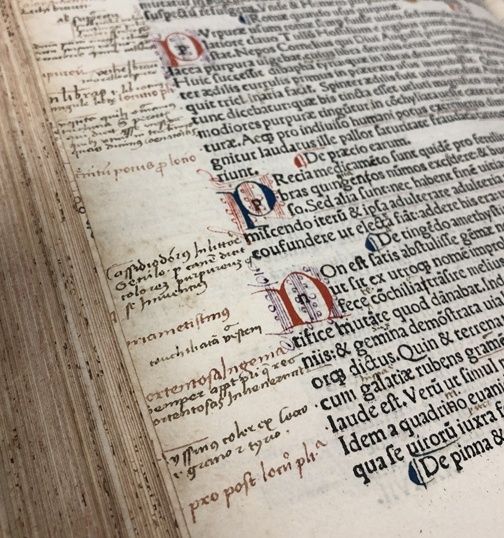
For these historical readers, a book was not necessarily a static monument. Its margins could become collaborative spaces where teachers, students, editors, and later owners added layers of thought. As printing spread and private reading became more common, the communal character of annotation gradually shifted toward a more solitary practice. Even so, the underlying principle remained: reading is strengthened when the reader explains, questions, and reorganizes what appears on the page. The long cultural history of this practice is traced in discussions of the tradition of marginalia, which reveal how annotations have functioned as evidence of interpretation as well as tools for learning.
The Reader Toolkit for Gentle Notation
The most useful annotation tool is usually the least dramatic one. Soft graphite offers enough contrast to remain visible without imposing itself on the page, and it can generally be erased more safely than ink. A pencil also encourages selectivity. Because every mark requires a small physical decision, readers are less likely to coat entire paragraphs in color and more likely to identify the sentence, term, or turn of argument that genuinely matters.
Tools should support concentration rather than turn reading into an elaborate craft project. A modest kit can include the following:
- A soft drafting pencil, preferably with a comfortable grip and a reliable eraser.
- Translucent sticky notes for longer reactions, cross-references, or quotations that do not fit in the margin.
- Removable page tabs for locating major themes without filling the edge of every page.
- An archival-quality eraser for light corrections, used gently and sparingly.
- A separate notebook or study book when the volume is borrowed, valuable, or unsuitable for writing.
Physical preservation depends less on avoiding all marks than on choosing them carefully. Keep notes short, avoid pressing hard enough to emboss the paper, and do not use adhesive materials that may stain or pull at the page. A personal rule such as “one underline per paragraph” or “no highlighting without a marginal response” creates useful discipline. For library books and borrowed volumes, removable tabs, loose notes, and a separate record protect the book while preserving the intellectual benefits of annotation. The best system is not the most decorative one. It is the one that leaves the physical book sound and allows the reader to keep thinking.
Designing a Personal Symbol Syntax
A small symbol system can make annotation faster because it reduces the need to write a full explanation every time a passage demands attention. The aim is not to create a secret code or an academic performance. It is to establish a few visible cues that help the eye recover the shape of an argument during review. A reader may use a vertical line for an important passage, a question mark for uncertainty, an exclamation point for an unexpected insight, and a short phrase for the reason the passage matters.
Annotation guides commonly recommend combining descriptions of the text with the reader”s own responses. The Research Guides reading strategy from Eastern Washington University, for example, frames annotation as a deliberate process for identifying main points, evidence, shifts in perspective, unfamiliar terms, and personal reactions. A compact symbol syntax can translate that principle into a practical page-level habit:
| Mark | Useful purpose | Example response |
|---|---|---|
| Vertical line | Important claim, definition, or passage | Use for the author”s central distinction |
| Question mark | Unclear reasoning, missing evidence, or unresolved question | What would count as proof here? |
| Exclamation point | Surprising connection or especially forceful idea | This explains the earlier example |
| Short bracket | Marks a complete section of reasoning | Evidence leading to conclusion |
| Two or three words | Captures a personal interpretation | Fear disguised as prudence |
Keep the system deliberately small. Four or five marks are usually enough, and their meanings should remain stable from book to book. Too many colors, categories, and abbreviations can interrupt reading rather than improve it. Symbols should be added while the idea is fresh, but their interpretation should remain obvious weeks or years later. If a question mark appears in the margin, it should remind the future reader what kind of uncertainty was present, not merely announce that confusion once occurred.
Building Front and Back Endpaper Indexes
Blank endpapers are among the most useful and overlooked spaces in a book. They can hold a bespoke index that is quicker to consult than a formal table of contents and more personal than an author”s subject index. The front endpaper works well for themes, definitions, and chapter references. The back can collect quotations, objections, related books, or insights that emerge only after the argument has been considered as a whole.
An effective index does not attempt to preserve everything. It captures what will help the reader return to the book with purpose. A few words beside a page number are often sufficient: “attention and distraction, 42,” “definition of judgment, 77,” or “strongest objection, 119.” The goal is rapid retrieval. Months later, these brief entries can guide a reader directly to the passages that shaped the book”s significance.
A steady four-step workflow keeps the practice useful rather than burdensome:
- Survey the book. Before close reading, inspect the title, contents, introduction, headings, bibliography, and any emphasized terms. Note the apparent subject and the questions the book seems prepared to address.
- Mark the developing argument. During reading, underline central claims, bracket supporting evidence, define unfamiliar vocabulary, and place short reactions beside passages that deserve later attention.
- Transfer selected entries. At the end of a chapter or reading session, move only the most useful themes, quotations, questions, and page references to the front or back endpaper. This prevents the index from becoming a second copy of the book.
- Synthesize after finishing. Add a brief account of the overall argument, its strongest evidence, its limitations, and the ideas it connects to elsewhere in the reader”s library.
The final step is where annotation becomes an enduring reference work. A book”s chapters may have been written separately, but the endpaper index can show how they depend on one another. It can also preserve the reader”s intellectual position at the time of reading. A note such as “persuasive but too narrow” or “connects with earlier work on memory” records more than content. It records judgment, context, and the beginning of further inquiry.
Turn Your Library into an Enduring Intellectual Archive
An annotated library is a physical history of changing attention. The marks in one book may reveal an early fascination, another may show a long-standing objection, and a third may contain a connection that became important only years later. These traces give reading a temporal dimension. They show not only what a book says, but what it asked of the reader at a particular stage of education, work, or life.
Re-reading an annotated volume can therefore feel like encountering both an old argument and an earlier version of the self. A confident note may later seem incomplete; a question once considered minor may become central; a sentence underlined years ago may acquire an entirely different force. That conversation across time is one of the quiet rewards of marking books. Choose a volume that matters, keep the tools simple, and begin with one careful pencil line. The page will remain a page, but it will also become evidence that reading was an active, continuing act of thought.